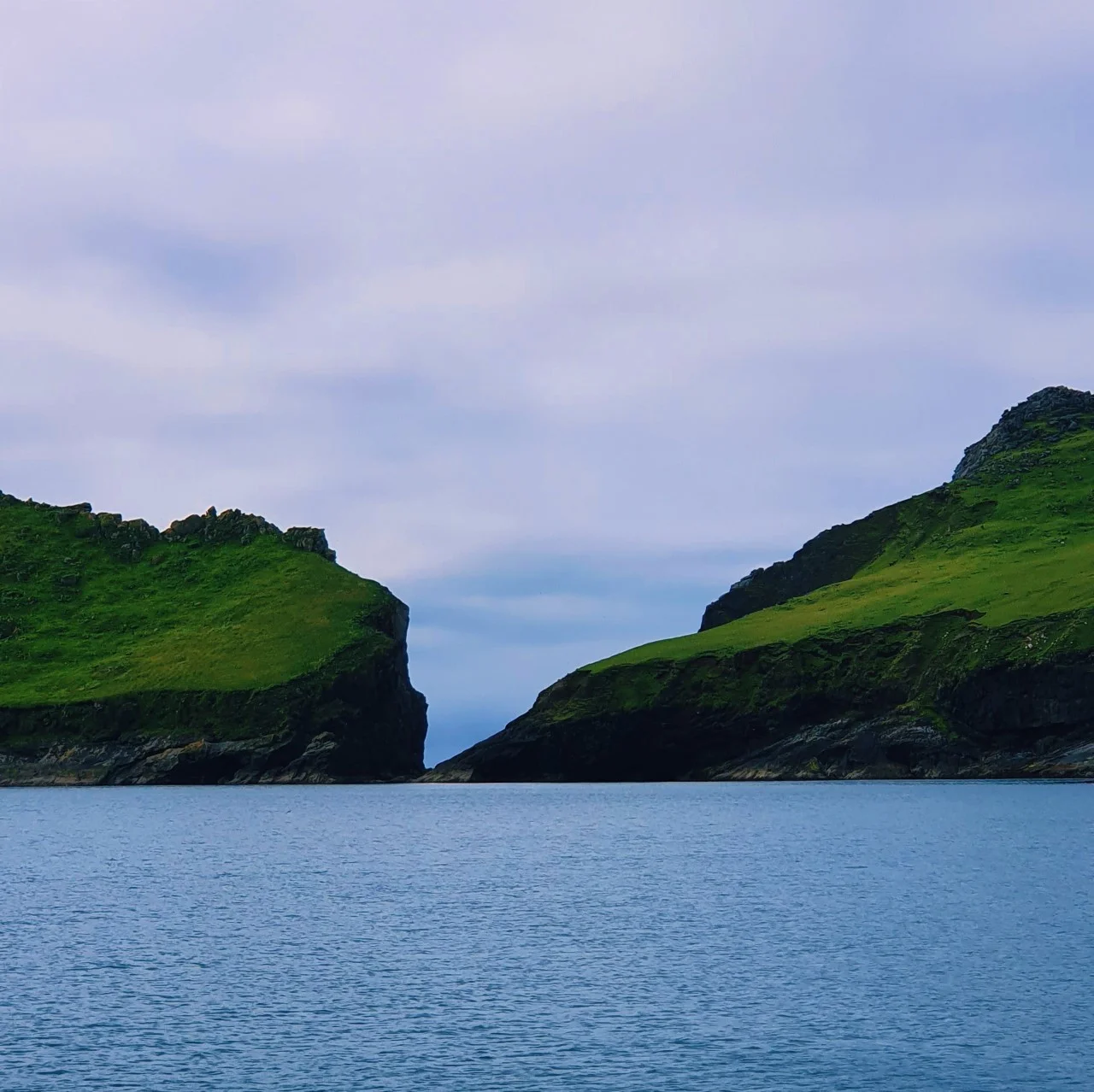
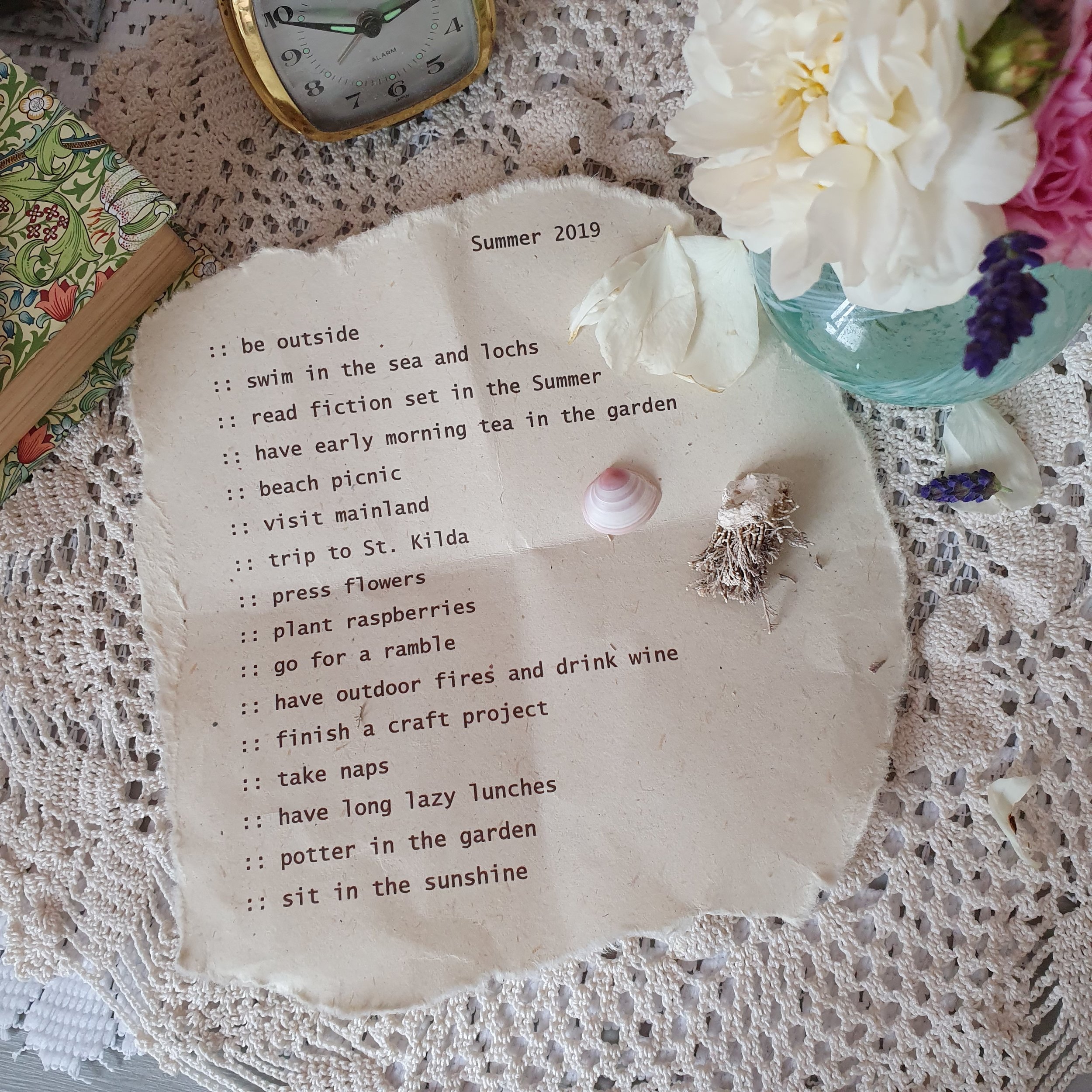
We went to St. Kilda on Saturday. It sounds almost normal when you say it like that - as if perhaps we went out to lunch. But lying 75 miles west into the Atlantic (from the Isle of Lewis) - this was no ordinary day out. Indeed, the sea journey is often arduous, and for that reason, it is not recommended for children under 12.
We have both wanted to go for some time, and so, finally, the required age having been reached, we set off on what felt like a kind of pilgrimage.
Its so easy to romanticise this far flung scattering of islands and sea stacks - and the story of the St. Kildans and their precarious lives, out there “on the edge of the world”. Although, I’ve come to realise that terms like “remote” and “edge of the world” are incredibly subjective. Remote from where? Edge of what? Surely West is always East of somewhere else?
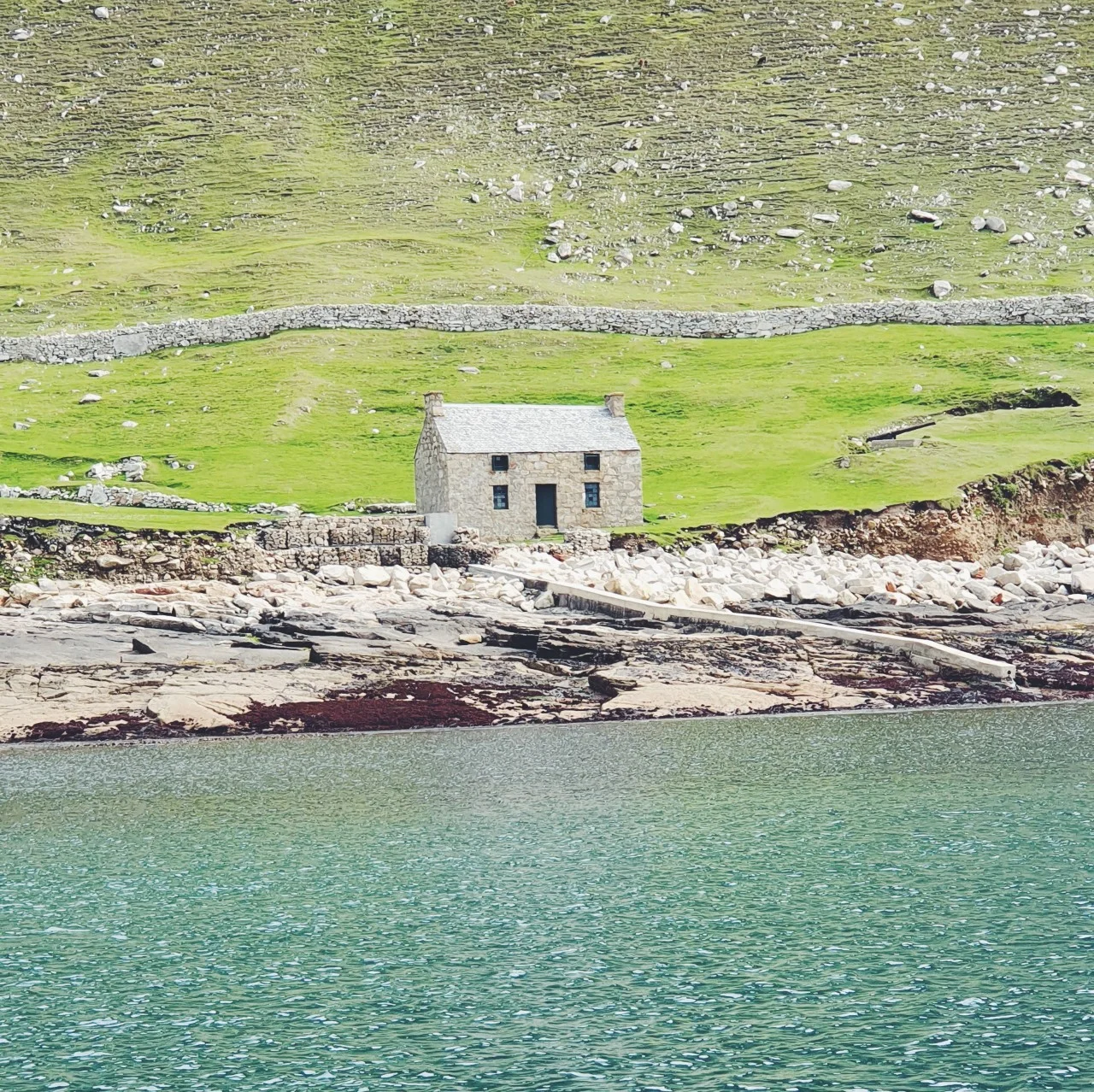
Nevertheless, it’s a fascinating tale. For four thousand years, people lived on Hirta, the largest of the islands. They grew crops, kept sheep and cattle, and harvested the sea birds and eggs. This way of life more or less continued until the 19th century when summer tourist boats began to visit the island. This led to the islanders becoming more reliant on income from the visitors, as well as the goods brought by the boats. As a consequence, their traditional way of life was abandoned in favour of tourism. The problem with this was that the boats could only call in the summer months, and so life during the rest of the year became extremely difficult, without the supplies they had come to rely on. The visitors brought infectious diseases with them too, and this led to a rise in mortality among the local population. This fact, and increasing rates of emigration exacerbated the situation. A sad but familiar tale of many indigenous populations.
In 1930, things reached a critical point and life there had become untenable. The remaining villagers asked the government to be evacuated to the mainland. This request was granted and at the end of August that year, the 36 remaining souls left their homes for the last time .
The archipelago is now owned by the National Trust for Scotland, and has double world heritage status, for culture and natural environment. Today, there are wardens in residence, as well as a seasonal archaeological team. There is also an Ministry of Defence radar base there.





![2019-11-13_07.44.29_2[1].jpg](https://images.squarespace-cdn.com/content/v1/5bdcc38ef407b4c5a07e8701/1573675975223-WFQCPRFB2Y1YBPBN6NDC/2019-11-13_07.44.29_2%5B1%5D.jpg)
![2019-11-13_07.44.31_2[1].jpg](https://images.squarespace-cdn.com/content/v1/5bdcc38ef407b4c5a07e8701/1573677274408-GSVFZKWUDC0H68MOD8ST/2019-11-13_07.44.31_2%5B1%5D.jpg)
![2019-11-13_07.44.31_1[1].jpg](https://images.squarespace-cdn.com/content/v1/5bdcc38ef407b4c5a07e8701/1573677408419-A8DACJITBYCIPCEPG28H/2019-11-13_07.44.31_1%5B1%5D.jpg)
![2019-11-13_07.44.29_1[1].jpg](https://images.squarespace-cdn.com/content/v1/5bdcc38ef407b4c5a07e8701/1573677636814-0IJR5V36PDNHZ57DVAG9/2019-11-13_07.44.29_1%5B1%5D.jpg)

![2019-11-13_07.44.30_1[1].jpg](https://images.squarespace-cdn.com/content/v1/5bdcc38ef407b4c5a07e8701/1573677815644-OR9MQI63U8FZ679QO4RR/2019-11-13_07.44.30_1%5B1%5D.jpg)
![2019-11-01_08.21.17_2[1].jpg](https://images.squarespace-cdn.com/content/v1/5bdcc38ef407b4c5a07e8701/1573677116715-UAAA6QVB0FB8O9I7MG6P/2019-11-01_08.21.17_2%5B1%5D.jpg)
![2019-11-13_01.23.20_4[1].jpg](https://images.squarespace-cdn.com/content/v1/5bdcc38ef407b4c5a07e8701/1573678706704-FQ53KG3O7MUMMKHIKF7M/2019-11-13_01.23.20_4%5B1%5D.jpg)
![2019-10-27_05.58.35_2[1].jpg](https://images.squarespace-cdn.com/content/v1/5bdcc38ef407b4c5a07e8701/1573677032351-3PTFEPBAK2KTW76Q4F5N/2019-10-27_05.58.35_2%5B1%5D.jpg)
![2019-11-12_01.50.11_2[1].jpg](https://images.squarespace-cdn.com/content/v1/5bdcc38ef407b4c5a07e8701/1573678528668-KIV62JF0U5C36PMFFPC1/2019-11-12_01.50.11_2%5B1%5D.jpg)